B&W dogs
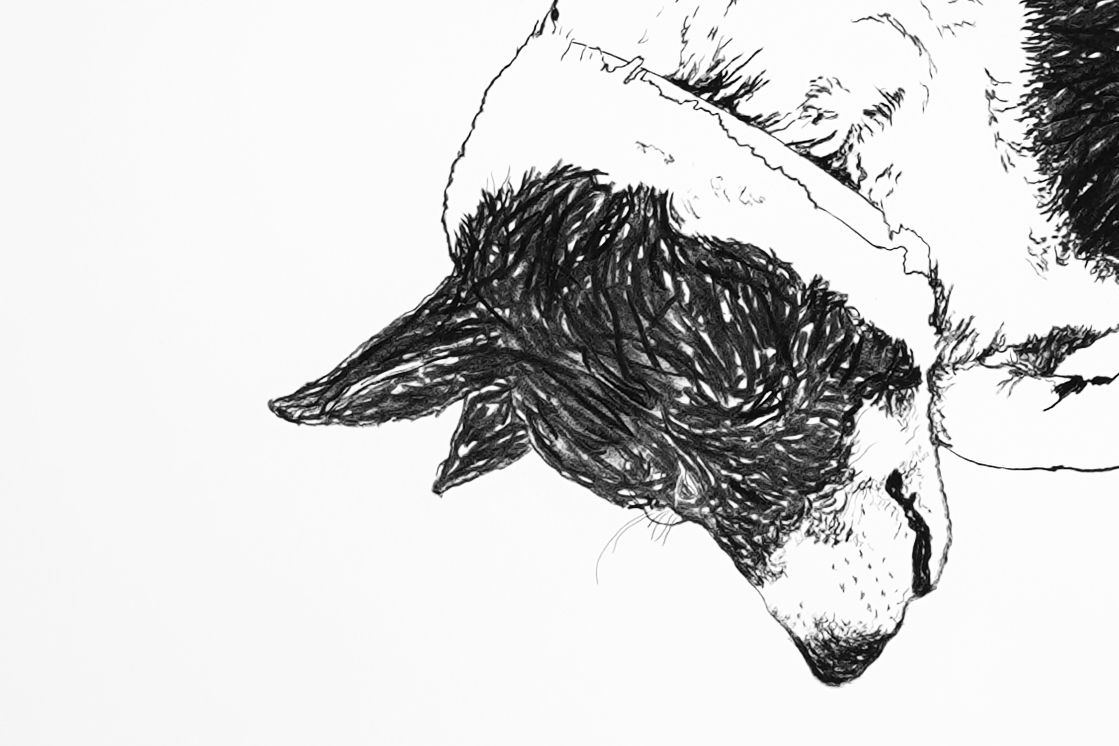
The figure of the dog, moreover, runs throughout the history of art as a true topos: from ancient painting to Renaissance courts, from aristocratic portraiture to nineteenth-century bourgeois contexts, and into contemporary practices, the dog has served as an emblem of fidelity, status, vigilance, domestic affection, or alterity, and as a seal within the work of a more-than-human condition. Within this long iconographic genealogy, “B&W Dogs” introduces a significant shift: it removes the dog from the allegorical and symbolic function that has often accompanied it, restoring it instead as an individual presence, unmediated by external narratives.
Each portrait arises from a prolonged encounter. Insistent observation precedes the graphic gesture, which is repeated with an almost compulsive discipline, as if drawing could stem the dispersal of experience. In this reiteration, a restrained tension becomes perceptible: charcoal excavates volumes, compresses shadows, lingers over gazes and postures. The mark does not caress, but interrogates; it does not idealize, but holds. The portrait thus becomes an exercise in radical attention, a practice of permanence against the inevitable dissolution of presence.
We are not confronted with symbolic figures nor allegorical transpositions. The dogs portrayed are individuals, recognized one by one. In the passage from reality to paper, however, their identity transforms: no longer a simple phenomenological datum, but the trace of a relationship. Each drawing testifies to a silent field of forces between the one who looks and the one who is looked at—a reciprocity that unsettles the traditional asymmetry of portraiture.
Within this displacement, an implicit reflection on speciesism takes root. The portrait acts as a suspension of hierarchies between human and nonhuman, removing the animal from the rhetoric of domestic affection or decorative function. The dogs are not sentimental emblems, but subjects endowed with an autonomous and irreducible presence. Black and white, in its severity, performs a further act of subtraction: it neutralizes outward differences and guides the image toward a dimension of radical equality. In this purified space, the distance between species loses centrality, and the differences of breed among the portrayed animals conceptually dissolve into the very matter of the drawing itself, where everything is reduced to the vibration of the mark and the density of the gaze.

charcoal on 100% cotton paper, 94 x 152 cm

charcoal on 100% cotton paper, 94 x 152 cm

charcoal on 100% cotton paper, 94 x 152 cm

charcoal on 100% cotton paper, 94 x 152 cm

charcoal on 100% cotton paper, 94 x 152 cm

charcoal on 100% cotton paper, 94 x 152 cm

charcoal on 100% cotton paper, 94 x 152 cm

charcoal on 100% cotton paper, 94 x 152 cm

charcoal on 100% cotton paper, 94 x 152 cm

charcoal on 100% cotton paper, 94 x 152 cm

charcoal on 100% cotton paper, 94 x 152 cm

charcoal on 100% cotton paper, 94 x 152 cm

charcoal on 100% cotton paper, 94 x 152 cm

charcoal on 100% cotton paper, 94 x 152 cm

charcoal on 100% cotton paper, 94 x 152 cm

charcoal on 100% cotton paper, 94 x 152 cm

charcoal on 100% cotton paper, 50 x 35 cm